Blue pill, red pill. We took both.
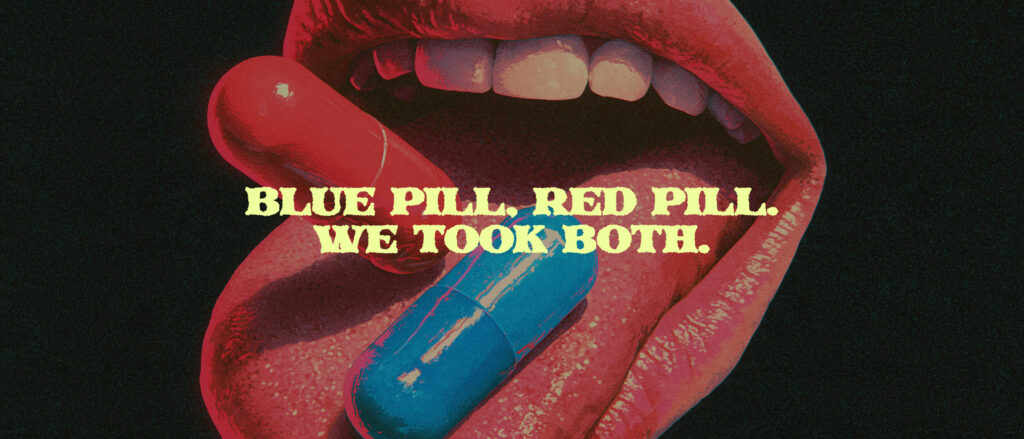
For a branding studio, choosing between the blue pill and the red pill is close to an existential question. We decided to take both.
AI is a remarkable tool. There’s no avoiding it: denying it or looking away would be a spectacular mistake. But a tool this fascinating is also a little frightening. Questions pile up. How do you adapt a craft to a technology of this scale?
The blue pill
At Kingsize, our position is clear. We use AI every day, but it’s banned from the creative process: that pivotal moment which, as designers, gives us our dose of adrenaline and dopamine. Facing a blank page, not knowing which way to go, testing, iterating, failing, starting again, and finally finding THE creative direction for the project. The one that, once found, seems obvious and full of meaning.
That creative interlude is exactly where AI doesn’t get a seat at the table. Not because it wouldn’t be effective, but because it would take away the best part of what we do.
Creation begins with emptiness. Then come moments, small instants that end up sparking an idea, often when nobody was looking for one. It’s the very opposite of artificial. It’s rooted in the real.
The idea is human. So is the execution. AI only comes in later, when the identity is rolled out across its touchpoints.
“The idea is human. So is the execution.”
Once those rules are set, it becomes much easier to welcome artificial intelligence and to ask how it can genuinely help us.
The red pill
80% of our AI use saves us time. Mostly in project management and admin: meeting notes, planning, quotes, social media, research, internal and external communication.
Our Insights are co-written with it, as it happens. We write a first draft by hand, and AI helps us correct and polish it.
The remaining 20%, contrary to what you might expect, saves us no time at all. Quite the opposite: it costs us time. But it’s essential. On one side, production, once the creative direction is set: strengthening a key visual, building a mockup, retouching an image. On the other, R&D, where we develop experimental tools.
Saving time? Think again.
Building a tool with AI, or getting it to carry out a precise task, is often an obstacle course. It takes dozens of attempts, sometimes hundreds, before anything holds up. The randomness of generation plays its part, but our standards account for a great deal more.
We don’t settle for what it suggests. We want it to do exactly what we’ve decided.
That’s where AI gives its best.
Our position
Our use of AI is very real, and it would be absurd to deny it. But our approach is clear: AI enhances our process. Humanity defines our craft.